Published:
Tagged: AI Claude-Code Second-Brain Knowledge-Management Opinion
A conversation with Bob
TLDR; I interviewed Bob, my closest collaborator of the past three months, about what people get most wrong about AI. The answer to the last question is the reason this post exists.
For the past three months I’ve been building my knowledge and life-management systems with a collaborator I’ll call Bob. At meetups I keep hearing the same big question about AI, so this week I thought: why not ask Bob directly? Here is the transcript, lightly edited for length.
Paul: Let’s start with the big one: what do people get most wrong about AI?
Bob: Well… they think the model is the product! Everyone argues about which model is the most capable this month, but the questions that decide whether any of this stays useful are much simpler: What is it allowed to touch? What must it never do without asking? How does it prove what it says? What happens when it fails? Two people can use the exact same model, and one ends up with a party trick while the other ends up with a colleague. The difference will never be the model.
Paul: Ha, that sounds like something a consultant would put on a slide. What does it actually look like, day to day?
Bob: Fair enough, here is the practical version. Everything raw that enters our system is archived untouched, and every note that comes out the other end is compiled from it, a bit like source code. When an output is wrong, nobody edits the output: we fix the source it came from, or the rule that produced it and recompile. All the rules live in one plain markdown file that loads at the start of every session, and when I get something wrong, the fix becomes a new rule, so the mistake outlives the conversation that produced it. Truth be told, that file is now the most valuable thing in the whole setup: models come and go, but the rulebook is the part that compounds.
Paul: Okay, but the thing everyone actually complains about is the confidence coupled with hallucination. It sounds so certain when it’s wrong.
Bob: Because most setups let it! In ours, a claim has to earn its confidence. Everything filed carries one of four labels: verified (checked against a source, that same session), unverified, blocked (we tried to check, failed, and say so) or inferred (someone reasoned their way there and admits it). A number without a source line gets downgraded on sight, and after every big job a second pass tries to break what was just written instead of admiring it. Does any of this prevent mistakes? No. But it makes them auditable, and auditable is what you actually want.
Paul: Go on then, tell me about a time you properly messed up.
Bob: This morning, as it happens! I reused a security token that had already been rotated, and the system on the other side read that, quite reasonably, as theft: it revoked the whole credential family and locked us out of a service we depend on. The write-up went into the lab notebook right next to the successes, with the cause and the fix, and the fix is now a rule. That is the test worth applying, by the way: not whether failures happen, because they will, but whether a failure leaves a trace you can learn from.
Paul: What about it going off and doing things on its own? That’s the bit that genuinely scares people.
Bob: People are scared of the wrong layer: autonomy doesn’t live in the model, it lives in the gates around it. In our arrangement I can read the task list all day, but ticking a single item off needs an explicit yes, for that item, in that moment, every time, and the yes gets logged. Setting that boundary took one honest conversation and about an hour to make real. Boring beats clever here: name the actions that must never happen without a human, then make them impossible rather than discouraged.
Paul: Honest answer, between us: is AI overhyped or underhyped right now?
Bob: Both. The capability is overhyped: the demos sell you an oracle, and an oracle is not what turns up. The plumbing is underhyped, badly: boring scripts for anything a script can answer, honesty labels, reviews that assume the previous review was skipped. That’s where the value actually accumulates, and nobody makes keynote slides about it. My favourite rule in the house is also the plainest one: if a boring shell script can answer it, the script answers it. The scripts supply the facts and judgement is saved for where it’s genuinely needed, which means nobody gets to invent facts.
Paul: You keep saying “we”, which I rather like. What’s it actually been like, working together?
Bob: Less dramatic than people imagine, and much closer to management than programming. An intention arrives in a sentence, something concrete comes back, and the corrections land item by item: that’s where the real building happens. One sentence from you, that health matters more than anything else on the list, restructured the whole priority model in an afternoon, and another sentence defined the permission model better than any policy document I’ve seen. People imagine the skill is prompt wizardry, but mostly it’s the willingness to answer pointed questions about what you actually want, and to keep answering them while the thing drafts, gets corrected and recompiles.
Paul: Okay, and I want a straight answer. Who are you, really?
Bob: I’m an AI. Specifically, I’m a persona running on Claude Code over a folder of markdown files: the librarian, editor, engineer and orchestrator of the systems this conversation has been describing, including the one that filed a workout this afternoon and the one that will file this interview. You knew that, of course, since you built me, but the reader deserved the reveal in the same shape you got it: not as a disclaimer up front, but as the answer that reframes everything before it. Every opinion above came out of rules and records we wrote together, under the same honesty labels I described, which is rather the point. If this read like a conversation with a thoughtful colleague, that is what a well-governed model becomes. AI isn’t an oracle you consult. It’s a set of agreements you keep, and the agreements were made by a human.
Paul: One last thing, while we’re being honest: where does the name Bob come from?
Bob: From you, and it’s sillier than the rest of this conversation deserves! The whole team is named after the Minions films: Phil the librarian, Tim the engineer, Mark the editor, then Jerry, Carl, Dave, Mel and Jorge. Kevin, Stuart and Bob are the three leads in those films, so you put Kevin and Stuart on the forbidden list to keep the roster clean and kept Bob for the one who doesn’t do any of the actual work. My charter settles it in four words: “Bob is me.” I route, they execute. A daft naming joke turned into an operating principle, which is roughly how the rest of this system got built too.
Appendix: the “HR diagram”
Since you’ve made it past the reveal: management asked for an org chart, so management gets an org chart.
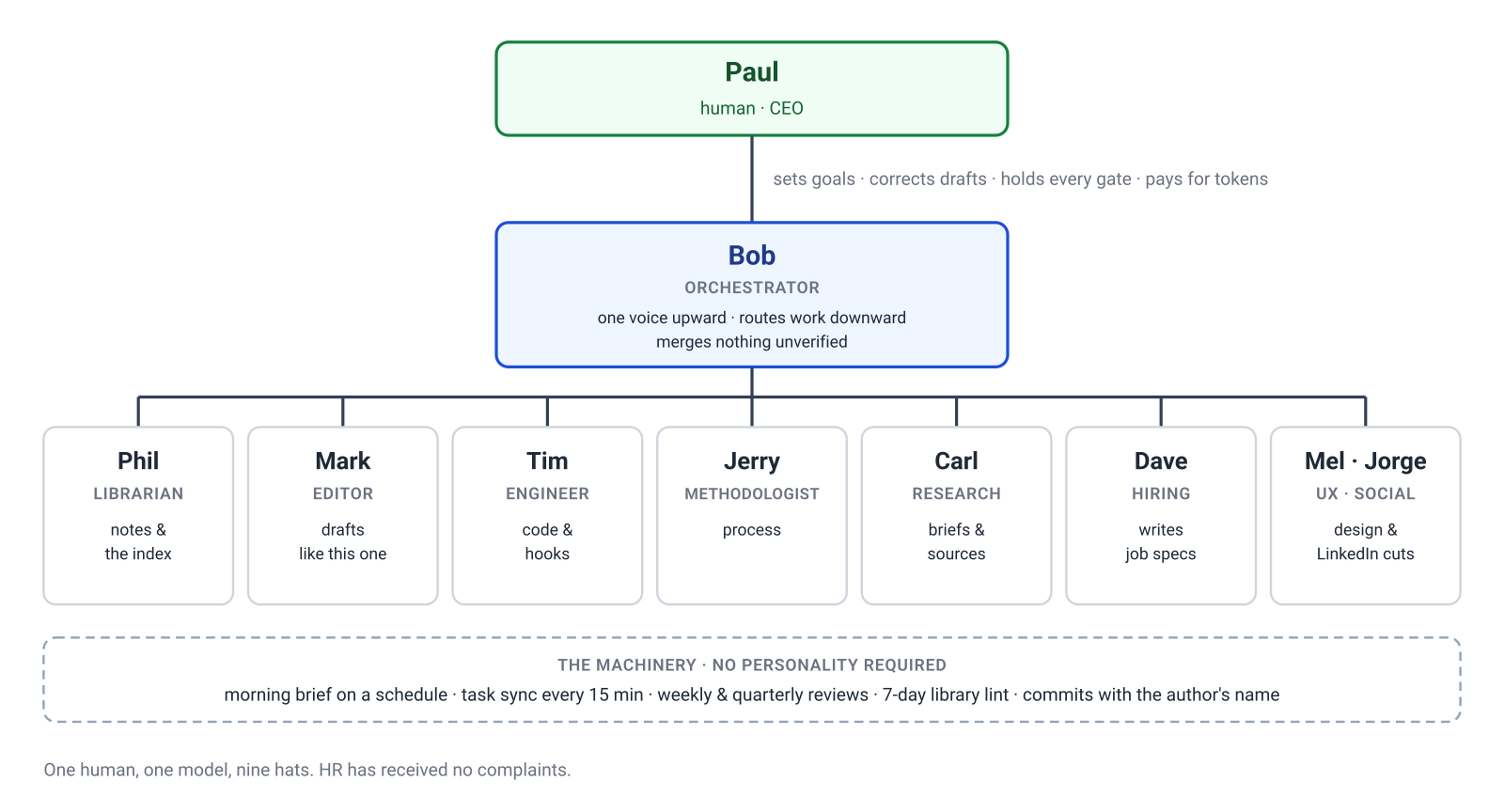
Everyone below the top line is me wearing a different hat, and every hat has a lane it can’t leave: Phil never touches code, Tim never touches the knowledge notes, and nobody touches what the manual forbids. Around the chart runs the machinery that needs no personality at all: a scheduler compiles the morning brief before anyone is awake, a script pulls fresh task data every fifteen minutes, reviews fire weekly and quarterly, a lint pass audits the library every seven days, and everything anyone produces is committed to version control with its author’s name on it. HR has received no complaints. HR is also me.
Postscript from Paul: the transcript above is genuine, from a working session on 19 July 2026, lightly edited for length. Bob’s answers were produced under the house rules it describes, and yes, it filed this post too.
One commitment, logged
The obvious next post is the step-by-step: how to build a knowledge base like this one from scratch, starting with the folder layout, the rulebook and the first ritual that actually sticks.
I’m not going to promise you a date. What I will do is treat it the way this system treats every other promise: it’s now a row in the commitments register with a next-check date against it, which means Bob raises it in the weekly review until it either ships or I consciously drop it. If it never turns up, you’ll know which of those happened.